Reposting the Vamadeva's article on Prana
Many Meanings of Prana
Prana has many levels of meaning from the breath to the energy of consciousness itself. Prana is not only the basic life-force, it is the master form of all energy working on the level of mind, life and body. Indeed the entire universe is a manifestation of Prana, which is the original creative power. Even Kundalini Shakti, the serpent power or inner power that transforms consciousness, develops from the awakened Prana.
The human being consists of five koshas or sheaths from the physical to subtle and causal principles:
- Annamaya kosha – food – physical – the five elements
- Pranamaya kosha – breath – vital – the five pranas
- Manomaya kosha – impressions – outer mind – the five kinds of sensory impressions
- Vijnanamaya kosha – ideas – intelligence – directed mental activity
- Anandamaya kosha – experiences – deeper mind – memory, subliminal and superconscious mind
Pranamaya Kosha:
The Pranamaya Kosha is the sphere of our vital life energies. This sheath mediates between the body on one side and the three sheaths of the mind (outer mind, intelligence and inner mind) on the other and has an action on both levels. It meditates between the five gross elements and the five sensory impressions.
The best English term for the Pranamaya kosha is probably the “vital sheath” or “vital body,” to use a term from Sri Aurobindo’s Integral Yoga. Pranamaya kosha consists of our vital urges of survival, reproduction, movement and self-expression, being mainly connected to the five motor organs (excretory, urino-genital, feet, hands, and vocal organ).
Most of us are dominated by the vital body and its deep-seated urges that are necessary for us to remain alive. It is also the home of the vital or subconscious ego which holds the various fears, desires and attachments which afflict us. We most of our spend our time in life seeking enjoyment through the vital in the form of sensory enjoyment and acquisition of material objects.
A person with a strong vital nature becomes prominent in life and is able to impress their personality upon the world. Those with a weak vital lack the power to accomplish much of anything and have little effect upon life, usually remaining in a subordinate position. Generally people with strong and egoistic vitals run the world, while those with weak vitals follow them. Such a strong egoistic vital is one of the greatest obstacles to the spiritual path.
A strong vital or Pranamaya kosha, however, is important for the spiritual path as well, but this is very different than the egoistic or desire oriented vital. It derives its strength not from our personal power but from surrender to the Divine and its great energy. Without a strong spiritual vital we lack the power to do our practices and not fall under worldly influences.
Yet Prana in various forms exists in all five koshas and is ultimately rooted in the Atman or inner Self beyond them. This Atmic Prana is the highest prana and grants healing and immortality of consciousness.
The Five Pranas
Pranamaya kosha is composed of the five Pranas. The one primary Prana divides into five types according to its movement and direction. This is an important subject in Ayurvedic medicine as well as Yogic thought.
Prana
Prana, literally the “forward moving air,” moves inward and governs reception of all types from the eating of food, drinking of water, and inhalation of air, to the reception of sensory impressions and mental experiences. It is propulsive in nature, setting things in motion and guiding them. It provides the basic energy that drives us in life. Ultimately it connects to the Purusha or the higher Self within.
Apana
Apana, literally the “air that moves away,” moves downward and outward and governs all forms of elimination and reproduction (which also has a downward movement). It governs the elimination of the stool and the urine, the expelling of semen, menstrual fluid and the fetus, and the elimination of carbon dioxide through the breath. On a deeper level it rules the elimination of negative sensory, emotional and mental experiences. It is the basis of our immune function on all levels.
Udana
Udana, literally the “upward moving air,” moves upward and qualitative or transformative movements of the life-energy. It governs growth of the body, the ability to stand, speech, effort, enthusiasm and will. It is our main positive energy in life through which we can develop our different bodies and evolve in consciousness.
Samana
Samana, literally the “balancing air,” moves from the periphery to the center, through a churning and discerning action. It aids in digestion on all levels. It works in the gastrointestinal tract to digest food, in the lungs to digest air or absorb oxygen, and in the mind to homogenize and digest experiences, whether sensory, emotional or mental.
Vyana
Vyana, literally the “outward moving air,” moves from the center to the periphery. It governs circulation on all levels. It moves the food, water and oxygen throughout the body, and keeps our emotions and thoughts circulating in the mind, imparting movement and providing strength. In doing so it assists all the other Pranas in their work.
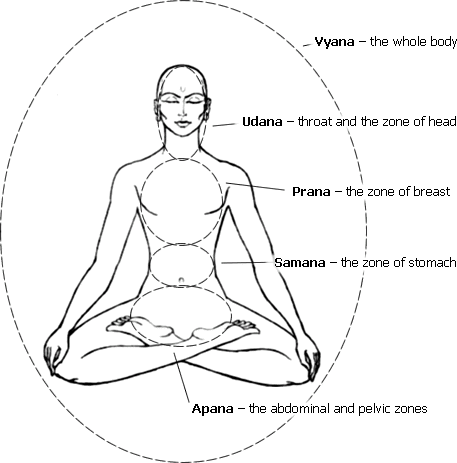
The five Pranas are energies and processes that occur on several levels in the body and mind. However we can localize them in a few key ways. Prana Vayu governs the movement of energy from the head down to the navel, which is the Pranic center in the physical body. Apana Vayu governs the movement of energy from the navel down to the root chakra. Samana Vayu governs the movement of energy from the entire body back to the navel. Vyana Vayu governs the movement of energy out from the navel throughout the entire body. Udana governs the movement of energy from the navel up to the head
As a simple summary we could say that Prana governs the intake of substances. Samana governs their digestion. Vyana governs the circulation of nutrients. Udana governs the release of positive energy. Apana governs the elimination of waste-materials.
This is much like the working of a machine. Prana brings in the fuel, Samana converts this fuel to energy, Vyana circulates the energy to the various work sites. Apana releases the waste materials or by products of the conversion process. Udana governs the positive energy created in the process and determines the work that the machine is able to do.
The key to health and well-being is to keep our Pranas in harmony. When one Prana becomes imbalanced, the others tend to become imbalanced as well because they are all linked together. Generally Prana and Udana work opposite to Apana as the forces of energization versus those of elimination. Similarly Vyana and Samana are opposites as expansion and contraction.
How Prana Creates The Physical Body
Without Prana the physical body is no more than a lump of clay. Prana sculpts this gelatinous mass into various limbs and organs. It does this by creating various channels or Nadis, through which it can operate and energize gross matter into various tissues and organs.
Prana Vayu creates the openings and channels in the head and brain down to the heart. There are seven openings in the head, the two eyes, two ears, two nostrils and mouth. These are called the seven Pranas or seven Rishis in Vedic thought. Udana assists Prana in creating the openings in the upper part of the body, particularly those of the mouth and vocal organs. The mouth, after all, is the main opening in the head and in the entire body. It could be said that the entire physical body is an extension of the mouth, which is the main organ of physical activity, eating and self-expression.
Apana Vayu creates the openings in the lower part of the body, those of the urino-genital and excretory systems. Samana Vayu creates the openings in the middle part of the body, those of the digestive system, centered in the navel. It opens out the channels of the intestines and the organs, like the liver and pancreas, which secrete into it. Vyana Vayu creates the channels going to the peripheral parts of the body, the arms and legs. It creates the veins and arteries and also the muscles, sinews, joints and bones.
In summary, Samana Vayu creates the trunk of the body (which is dominated by the gastro-intestinal tract), while Vyana Vayu creates the limbs. Prana and Udana create the upper openings or bodily orifices, while Apana creates those below.
Prana however exists not just on a physical level. The navel is the main vital center for the physical body. The heart is the main center for the Pranamaya Kosha. The head is the main center for Manomaya kosha.
Prana and the Mind
The mind also has its energy and Prana. This derives from food, breath and impressions externally. Prana governs the intake of sensory impressions. Samana governs mental digestion. Vyana governs mental circulation. Apana governs the elimination of toxic ideas and negative emotions. Udana governs positive mental energy, strength and enthusiasm. The Five Pranas work upon the mind in ways a little different than they do on the physical body as their action is at a subtle level.
- On a psychological level, Prana governs our receptivity to positive sources of nourishment, feeling and knowledge through the mind and senses. When deranged it causes wrong desire and insatiable craving. We become misguided, misdirected and generally out of balance.
- Apana on a psychological level governs our ability to eliminate negative thoughts and emotions. When deranged it causes depression and we get clogged up with undigested experience that weighs us down in life, making us fearful, suppressed and weak.
- Samana Vayu gives us nourishment, contentment and balance in the mind. When deranged it brings about attachment and greed. We cling to things and become possessive in our behavior.
- Vyana Vayu gives us free movement and independence in the mind. When deranged it causes isolation, hatred, and alienation. We are unable to unite with others or remain connected in what we do.
- Udana gives us joy and enthusiasm and helps awaken our higher spiritual and creative potentials. When deranged it causes pride and arrogance. We become ungrounded, trying to go to high and lose track of our roots.
Higher Yogic Aspects of the Five Pranas
The Pranas have many special actions in Yogic practices. On a spiritual level, Samana Vayu governs the space within the heart (antar hridyakasha) in which the true Self, the Atman dwells as a fire with seven flames, governs the central internal space or antariksha. Samana regulates Agni with fuel, which must burn evenly. Without the peace and balance of Samana we cannot return to the core of our being or concentrate the mind.
Vyana governs the movement of Prana through the Nadis, keeping them open, clear, clean and even in their functioning. Apana protects us from negative astral influences and false teachers. Prana itself gives us the proper aspiration for our spiritual development.
Udana governs our growth in consciousness and takes the mind into the state of sleep and into the after death realms. Udana also governs the movement up the sushumna, including the awakening of the Kundalini.
The mind moves with Udana Vayu. This takes us to the states of dream and deep sleep. After death it leads the soul to the astral and causal planes. Udana is often the most important Prana for spiritual growth. It also governs mantra.
As we practice Yoga the subtle aspects of these Pranas begin to awaken. This may cause various unusual movements of energy in body and mind, including the occurrence of various spontaneous movements or kriyas. We may feel new expanses of energy (subtle Vyana), great peace (subtle Samana), a sense of lightness or levitation (subtle Udana), deep groundedness and stability (subtle Apana), or just heightened vitality and sensitivity (subtle Prana).
Working On Prana
Proper nutrition brings about the increase of Prana on a physical level. This also requires proper elimination. In Ayurvedic thought the Prana from the food is absorbed in the large intestine, particularly in the upper two-thirds of this organ, which is not simply an organ of elimination. For this reason Apana Vayu is the most important Prana for physical health.
The Vedas say that mortals eat food with Apana, while the Gods eat food with Prana. The mortals are the physical tissues. The immortals are the senses. These take in food via Prana itself. Right food sustains Apana. Right impressions support Prana. For this not only outer factors like contact with nature, but also practices like rituals and visualizations are important, as well as sensory therapies involving color, sounds or aromas.
Pranayama
The main method for working on Prana is Pranayama or Yogic breathing exercises. Yoga emphasizes purification of the body (deha suddhi) and purification of the mind (citta suddhi) as the means to Self-realization. For this reason Yoga emphasizes a vegetarian diet rich in Prana or foods full of the life-force and a mind rooted in ethical values like truthfulness and non-violence. An impure, toxic or disturbed body and mind cannot realize the higher Self. However the key to purifying body and mind is prana. For this purpose the main method is purification of the nadis or channels through which Prana flows (Nadi-sodhana).
While all Pranayama aids in this regard, the most important is alternate nostril breathing, which aids in the balance of the right and left Prana currents. According to the Yogic system the body and all of its channels follow a right or left predominance. The right side of the body is masculine or solar in nature. The left side is feminine or lunar in nature. The left or the lunar nadi, is Kapha or water predominant, and increases energy on the left side of the body. It aids in such activities as rest, sleep, relaxation. The right or solar nadi is Pitta or fire predominant and increases energy on the right side. It aids in such activities as digestion, work, and concentration.
Regular alternate nostril breathing is the most important method for keeping our Pranas or energies in balance. It helps create the unitary prana necessary to sustain unitary awareness.
Another method is uniting Prana and Apana. Apana, which is aligned with the force of gravity, usually moves downward resulting not only in disease and death but in the downward movement of consciousness. Prana, on the other hand, tends to disperse upward through the mind and senses, as it is our opening to the energies above.
Yogic practices require bringing Apana up. Prana must be brought down to unite with Apana. This helps unite and balance all the Pranas. In doing so the inner fire or Kundalini gets enkindled in the region of the navel. Mula Bandha is an important practice in this regard. The goal is to balance our outer and physical pranas and awaken higher and inner pranas of deeper awareness.
Mantra and Meditation
Breathing practices work with Pranamaya Kosha. However the Pranas or energies in the mind can be dealt with directly as well. Color and sound (music) are important ways to direct energy in the mind. The best technique is mantra, particularly single syllable or bija mantras like OM, which create vibrations (nada) that can help direct energy into the subconscious.
Meditation itself, creating space in the mind, serves to create more Prana in the mind. When the mind is brought to a silent and receptive condition, like the expanse of the sky, a new energy comes into being within it that brings about great transformations.
Indeed all the paths of Yoga are based upon Prana. Bhakti Yoga or the Yoga of Devotion brings about Pranic transformation by uniting us with the Divine Will and Divine Prana. All Karma Yoga or service is based upon alignment with the Divine Will as well. This also gives us more Prana, not only to act outwardly but for inner development.
Classical Yoga or Raja Yoga is based upon the control of mental activities (Citta-vrittis). The vibration of the mind (Citta-spanda) follows the vibration of Prana (Prana-spanda). Therefore Pranayama helps control the mind. It also helps control the senses (Pratyahara) because it withdraws our awareness inward from the senses. Hatha Yoga itself is mainly concerned with Prana and even Asana occurs as an expression of Prana. Many great Yogis did not learn Asana through mechanical practice but were taught Asana by the power of their awakened Prana.
Even Jnana Yoga or the Yoga of Knowledge depends upon a strong will and concentration. Without a well-developed Udana Vayu it cannot succeed. In the Yoga of Knowledge the Prana of inquiry must be created, which is to inquire into our true nature not merely mentally but in all of our daily activities. This requires that inquiry occurs through Prana and not simply through the outer mind.
Indeed as the Vedas say we are all under the control of Prana. Prana is said to be the Sun that imparts life and light to all and dwells within the heart as the Self of all creatures. Prana in us makes us live and allows us to act. It is not the puny little ego, ascribing Prana’s effects to its own power, that really does anything. We must learn to be open to and welcome this greater force of Prana and seek to bring it into our life and action. This is one of the great secrets of Yoga.
Vamadeva
Reposted above article from American institute of vedic studies, vedanet.com
Body Type - Yoga
Ayurveda talks a great deal about hatha yoga and prescribes different asanas according to Prakriti and Vikruti (personal constitution). Vata types should practice camel, cobra, and cow. Boat, bow, bridge, and fish poses are good for Pitta. Lotus, locust, lion and palm tree is good for Kapha. Surya Namaskar, sun salutation, is tridoshic and can be practiced by anyone. You should do 25 sun salutations and then several asanas that are good for your specific dosha. Pitta people can do moon salutation, which is little gentler and help to keep Pitta under control. Kapha types should do vigorous Sun Salutations and then practice their appropriate asanas at the end. Yoga practiced in this way becomes therapeutic and can be used to balance one’s dosha. Yoga helps to maintain balance. Balance between body, mind, and consciousness unfolds real inner happiness.
From Dr.Vasant Lad