Sunday, December 6, 2020

Dec 5th - 6th Sequence

 Dec 5th Sequence:

Seated variations:

Vajrasan

Wide kneed Vajrasan

Veerasan

One leg on Veerasan, one utthita - knee to ceiling position

Pawanmuktasan:Supine position

Leg lift

Cycling

Twist side to side

Adho mukha - leg extension

Surya Namskar

Veerbhadrasan 2

Vashishtasan variation from Table top

Shalabhasan

Modified Bhujangasan

Dhanurasan

Sashtanga rolls

Dec 6th

Different ways of sitting

Supine - 3 hip positions

Leg lifts

Uttnasana to Malasan - hands holding the feet

Side stretch, Clasping the fingers, Straignht hands

Surya Namskar

Chandra Namaskar

Veerabhadrasan 2 variations

Modified Handstand

Supported sarvangasan


Wednesday, September 23, 2020

Secrets of the five pranas

 Reposting the Vamadeva's article on Prana 


Many Meanings of Prana

Prana has many levels of meaning from the breath to the energy of consciousness itself. Prana is not only the basic life-force, it is the master form of all energy working on the level of mind, life and body. Indeed the entire universe is a manifestation of Prana, which is the original creative power. Even Kundalini Shakti, the serpent power or inner power that transforms consciousness, develops from the awakened Prana.


The human being consists of five koshas or sheaths from the physical to subtle and causal principles:

  1. Annamaya kosha – food – physical – the five elements
  2. Pranamaya kosha – breath – vital – the five pranas
  3. Manomaya kosha – impressions – outer mind – the five kinds of sensory impressions
  4. Vijnanamaya kosha – ideas – intelligence – directed mental activity
  5. Anandamaya kosha – experiences – deeper mind – memory, subliminal and superconscious mind

Pranamaya Kosha:

The Pranamaya Kosha is the sphere of our vital life energies. This sheath mediates between the body on one side and the three sheaths of the mind (outer mind, intelligence and inner mind) on the other and has an action on both levels. It meditates between the five gross elements and the five sensory impressions.

The best English term for the Pranamaya kosha is probably the “vital sheath” or “vital body,” to use a term from Sri Aurobindo’s Integral Yoga. Pranamaya kosha consists of our vital urges of survival, reproduction, movement and self-expression, being mainly connected to the five motor organs (excretory, urino-genital, feet, hands, and vocal organ).

Most of us are dominated by the vital body and its deep-seated urges that are necessary for us to remain alive. It is also the home of the vital or subconscious ego which holds the various fears, desires and attachments which afflict us. We most of our spend our time in life seeking enjoyment through the vital in the form of sensory enjoyment and acquisition of material objects.

A person with a strong vital nature becomes prominent in life and is able to impress their personality upon the world. Those with a weak vital lack the power to accomplish much of anything and have little effect upon life, usually remaining in a subordinate position. Generally people with strong and egoistic vitals run the world, while those with weak vitals follow them. Such a strong egoistic vital is one of the greatest obstacles to the spiritual path.

A strong vital or Pranamaya kosha, however, is important for the spiritual path as well, but this is very different than the egoistic or desire oriented vital. It derives its strength not from our personal power but from surrender to the Divine and its great energy. Without a strong spiritual vital we lack the power to do our practices and not fall under worldly influences.

Yet Prana in various forms exists in all five koshas and is ultimately rooted in the Atman or inner Self beyond them. This Atmic Prana is the highest prana and grants healing and immortality of consciousness.


The Five Pranas

Pranamaya kosha is composed of the five Pranas. The one primary Prana divides into five types according to its movement and direction. This is an important subject in Ayurvedic medicine as well as Yogic thought.


Prana

Prana, literally the “forward moving air,” moves inward and governs reception of all types from the eating of food, drinking of water, and inhalation of air, to the reception of sensory impressions and mental experiences. It is propulsive in nature, setting things in motion and guiding them. It provides the basic energy that drives us in life. Ultimately it connects to the Purusha or the higher Self within.


Apana

Apana, literally the “air that moves away,” moves downward and outward and governs all forms of elimination and reproduction (which also has a downward movement). It governs the elimination of the stool and the urine, the expelling of semen, menstrual fluid and the fetus, and the elimination of carbon dioxide through the breath. On a deeper level it rules the elimination of negative sensory, emotional and mental experiences. It is the basis of our immune function on all levels.


Udana

Udana, literally the “upward moving air,” moves upward and qualitative or transformative movements of the life-energy. It governs growth of the body, the ability to stand, speech, effort, enthusiasm and will. It is our main positive energy in life through which we can develop our different bodies and evolve in consciousness.


Samana

Samana, literally the “balancing air,” moves from the periphery to the center, through a churning and discerning action. It aids in digestion on all levels. It works in the gastrointestinal tract to digest food, in the lungs to digest air or absorb oxygen, and in the mind to homogenize and digest experiences, whether sensory, emotional or mental.


Vyana

Vyana, literally the “outward moving air,” moves from the center to the periphery. It governs circulation on all levels. It moves the food, water and oxygen throughout the body, and keeps our emotions and thoughts circulating in the mind, imparting movement and providing strength. In doing so it assists all the other Pranas in their work.


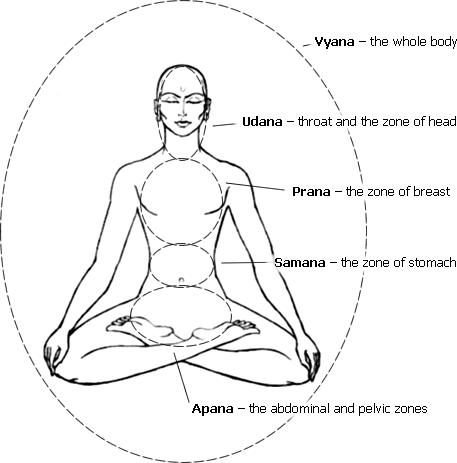
The five Pranas are energies and processes that occur on several levels in the body and mind. However we can localize them in a few key ways. Prana Vayu governs the movement of energy from the head down to the navel, which is the Pranic center in the physical body. Apana Vayu governs the movement of energy from the navel down to the root chakra. Samana Vayu governs the movement of energy from the entire body back to the navel. Vyana Vayu governs the movement of energy out from the navel throughout the entire body. Udana governs the movement of energy from the navel up to the head

As a simple summary we could say that Prana governs the intake of substances. Samana governs their digestion. Vyana governs the circulation of nutrients. Udana governs the release of positive energy. Apana governs the elimination of waste-materials.

This is much like the working of a machine. Prana brings in the fuel, Samana converts this fuel to energy, Vyana circulates the energy to the various work sites. Apana releases the waste materials or by products of the conversion process. Udana governs the positive energy created in the process and determines the work that the machine is able to do.

The key to health and well-being is to keep our Pranas in harmony. When one Prana becomes imbalanced, the others tend to become imbalanced as well because they are all linked together. Generally Prana and Udana work opposite to Apana as the forces of energization versus those of elimination. Similarly Vyana and Samana are opposites as expansion and contraction.


How Prana Creates The Physical Body

Without Prana the physical body is no more than a lump of clay. Prana sculpts this gelatinous mass into various limbs and organs. It does this by creating various channels or Nadis, through which it can operate and energize gross matter into various tissues and organs.

Prana Vayu creates the openings and channels in the head and brain down to the heart. There are seven openings in the head, the two eyes, two ears, two nostrils and mouth. These are called the seven Pranas or seven Rishis in Vedic thought. Udana assists Prana in creating the openings in the upper part of the body, particularly those of the mouth and vocal organs. The mouth, after all, is the main opening in the head and in the entire body. It could be said that the entire physical body is an extension of the mouth, which is the main organ of physical activity, eating and self-expression.

Apana Vayu creates the openings in the lower part of the body, those of the urino-genital and excretory systems. Samana Vayu creates the openings in the middle part of the body, those of the digestive system, centered in the navel. It opens out the channels of the intestines and the organs, like the liver and pancreas, which secrete into it. Vyana Vayu creates the channels going to the peripheral parts of the body, the arms and legs. It creates the veins and arteries and also the muscles, sinews, joints and bones.

In summary, Samana Vayu creates the trunk of the body (which is dominated by the gastro-intestinal tract), while Vyana Vayu creates the limbs. Prana and Udana create the upper openings or bodily orifices, while Apana creates those below.

Prana however exists not just on a physical level. The navel is the main vital center for the physical body. The heart is the main center for the Pranamaya Kosha. The head is the main center for Manomaya kosha.


Prana and the Mind

The mind also has its energy and Prana. This derives from food, breath and impressions externally. Prana governs the intake of sensory impressions. Samana governs mental digestion. Vyana governs mental circulation. Apana governs the elimination of toxic ideas and negative emotions. Udana governs positive mental energy, strength and enthusiasm. The Five Pranas work upon the mind in ways a little different than they do on the physical body as their action is at a subtle level.

  • On a psychological level, Prana governs our receptivity to positive sources of nourishment, feeling and knowledge through the mind and senses. When deranged it causes wrong desire and insatiable craving. We become misguided, misdirected and generally out of balance.
  • Apana on a psychological level governs our ability to eliminate negative thoughts and emotions. When deranged it causes depression and we get clogged up with undigested experience that weighs us down in life, making us fearful, suppressed and weak.
  • Samana Vayu gives us nourishment, contentment and balance in the mind. When deranged it brings about attachment and greed. We cling to things and become possessive in our behavior.
  • Vyana Vayu gives us free movement and independence in the mind. When deranged it causes isolation, hatred, and alienation. We are unable to unite with others or remain connected in what we do.
  • Udana gives us joy and enthusiasm and helps awaken our higher spiritual and creative potentials. When deranged it causes pride and arrogance. We become ungrounded, trying to go to high and lose track of our roots.


Higher Yogic Aspects of the Five Pranas

The Pranas have many special actions in Yogic practices. On a spiritual level, Samana Vayu governs the space within the heart (antar hridyakasha) in which the true Self, the Atman dwells as a fire with seven flames, governs the central internal space or antariksha. Samana regulates Agni with fuel, which must burn evenly. Without the peace and balance of Samana we cannot return to the core of our being or concentrate the mind.

Vyana governs the movement of Prana through the Nadis, keeping them open, clear, clean and even in their functioning. Apana protects us from negative astral influences and false teachers. Prana itself gives us the proper aspiration for our spiritual development.

Udana governs our growth in consciousness and takes the mind into the state of sleep and into the after death realms. Udana also governs the movement up the sushumna, including the awakening of the Kundalini.

The mind moves with Udana Vayu. This takes us to the states of dream and deep sleep. After death it leads the soul to the astral and causal planes. Udana is often the most important Prana for spiritual growth. It also governs mantra.

As we practice Yoga the subtle aspects of these Pranas begin to awaken. This may cause various unusual movements of energy in body and mind, including the occurrence of various spontaneous movements or kriyas. We may feel new expanses of energy (subtle Vyana), great peace (subtle Samana), a sense of lightness or levitation (subtle Udana), deep groundedness and stability (subtle Apana), or just heightened vitality and sensitivity (subtle Prana).


Working On Prana

Proper nutrition brings about the increase of Prana on a physical level. This also requires proper elimination. In Ayurvedic thought the Prana from the food is absorbed in the large intestine, particularly in the upper two-thirds of this organ, which is not simply an organ of elimination. For this reason Apana Vayu is the most important Prana for physical health.

The Vedas say that mortals eat food with Apana, while the Gods eat food with Prana. The mortals are the physical tissues. The immortals are the senses. These take in food via Prana itself. Right food sustains Apana. Right impressions support Prana. For this not only outer factors like contact with nature, but also practices like rituals and visualizations are important, as well as sensory therapies involving color, sounds or aromas.


Pranayama

The main method for working on Prana is Pranayama or Yogic breathing exercises. Yoga emphasizes purification of the body (deha suddhi) and purification of the mind (citta suddhi) as the means to Self-realization. For this reason Yoga emphasizes a vegetarian diet rich in Prana or foods full of the life-force and a mind rooted in ethical values like truthfulness and non-violence. An impure, toxic or disturbed body and mind cannot realize the higher Self. However the key to purifying body and mind is prana. For this purpose the main method is purification of the nadis or channels through which Prana flows (Nadi-sodhana).

While all Pranayama aids in this regard, the most important is alternate nostril breathing, which aids in the balance of the right and left Prana currents. According to the Yogic system the body and all of its channels follow a right or left predominance. The right side of the body is masculine or solar in nature. The left side is feminine or lunar in nature. The left or the lunar nadi, is Kapha or water predominant, and increases energy on the left side of the body. It aids in such activities as rest, sleep, relaxation. The right or solar nadi is Pitta or fire predominant and increases energy on the right side. It aids in such activities as digestion, work, and concentration.

Regular alternate nostril breathing is the most important method for keeping our Pranas or energies in balance. It helps create the unitary prana necessary to sustain unitary awareness.

Another method is uniting Prana and Apana. Apana, which is aligned with the force of gravity, usually moves downward resulting not only in disease and death but in the downward movement of consciousness. Prana, on the other hand, tends to disperse upward through the mind and senses, as it is our opening to the energies above.

Yogic practices require bringing Apana up. Prana must be brought down to unite with Apana. This helps unite and balance all the Pranas. In doing so the inner fire or Kundalini gets enkindled in the region of the navel. Mula Bandha is an important practice in this regard. The goal is to balance our outer and physical pranas and awaken higher and inner pranas of deeper awareness.


Mantra and Meditation

Breathing practices work with Pranamaya Kosha. However the Pranas or energies in the mind can be dealt with directly as well. Color and sound (music) are important ways to direct energy in the mind. The best technique is mantra, particularly single syllable or bija mantras like OM, which create vibrations (nada) that can help direct energy into the subconscious.

Meditation itself, creating space in the mind, serves to create more Prana in the mind. When the mind is brought to a silent and receptive condition, like the expanse of the sky, a new energy comes into being within it that brings about great transformations.

Indeed all the paths of Yoga are based upon Prana. Bhakti Yoga or the Yoga of Devotion brings about Pranic transformation by uniting us with the Divine Will and Divine Prana. All Karma Yoga or service is based upon alignment with the Divine Will as well. This also gives us more Prana, not only to act outwardly but for inner development.

Classical Yoga or Raja Yoga is based upon the control of mental activities (Citta-vrittis). The vibration of the mind (Citta-spanda) follows the vibration of Prana (Prana-spanda). Therefore Pranayama helps control the mind. It also helps control the senses (Pratyahara) because it withdraws our awareness inward from the senses. Hatha Yoga itself is mainly concerned with Prana and even Asana occurs as an expression of Prana. Many great Yogis did not learn Asana through mechanical practice but were taught Asana by the power of their awakened Prana.

Even Jnana Yoga or the Yoga of Knowledge depends upon a strong will and concentration. Without a well-developed Udana Vayu it cannot succeed. In the Yoga of Knowledge the Prana of inquiry must be created, which is to inquire into our true nature not merely mentally but in all of our daily activities. This requires that inquiry occurs through Prana and not simply through the outer mind.

Indeed as the Vedas say we are all under the control of Prana. Prana is said to be the Sun that imparts life and light to all and dwells within the heart as the Self of all creatures. Prana in us makes us live and allows us to act. It is not the puny little ego, ascribing Prana’s effects to its own power, that really does anything. We must learn to be open to and welcome this greater force of Prana and seek to bring it into our life and action. This is one of the great secrets of Yoga.

Vamadeva

Reposted above article from American institute of vedic studies, vedanet.com

Body Type - Yoga

Ayurveda talks a great deal about hatha yoga and prescribes different asanas according to Prakriti and Vikruti (personal constitution). Vata types should practice camel, cobra, and cow. Boat, bow, bridge, and fish poses are good for Pitta. Lotus, locust, lion and palm tree is good for Kapha. Surya Namaskar, sun salutation, is tridoshic and can be practiced by anyone. You should do 25 sun salutations and then several asanas that are good for your specific dosha. Pitta people can do moon salutation, which is little gentler and help to keep Pitta under control. Kapha types should do vigorous Sun Salutations and then practice their appropriate asanas at the end. Yoga practiced in this way becomes therapeutic and can be used to balance one’s dosha. Yoga helps to maintain balance. Balance between body, mind, and consciousness unfolds real inner happiness.

From Dr.Vasant Lad

Pancha Vayus

 This is a repost of Subash's blog published on Feb 1, 2018


The Five Pranas

pranas
Five Pranas

The word “prana” (prāṇa – प्राण) is derived from the Sanskrit root word “an” (अन्) with the prefix “pra” added. “an” means to breathe. When we add the prefix “pra” then prana assumes a much broader meaning in addition to simply the breath. Prana can mean the cosmic life force or the individual vital life energy. It is the life force or the life principle that keeps us “alive”. In many parts of India, when a person dies, the statement made is “prana left the person’s body” and the implication is that the person is dead. At the time of death some of the organs in the body like the liver, kidney, eyes etc. may still be functional. In fact, that is how organ transplant is done from a cadaver. The only reason these organs are of no use in the body is because there is no prana in the body. In a different body where the prana is still there, this organ can replace the damaged organ and resume normal function.  

There is a story about Prana that we find in ancient texts, the Upanishads. Our five main faculties – the mind, breath (prana), speech, ear and eye – were arguing with each other as to which one of them was the best and most important. To resolve this dispute they decided that each would leave the body and see whose absence was most missed.

First speech left the body but the body continued though mute. Next the eye left but the body continued though blind. Next the ear left but the body continued though deaf. Mind left but the body continued though unconscious. Finally the Prana began to leave and the body began to die and all the other faculties began to lose their energy. So they all rushed to Prana and told it to stay, acknowledging its supremacy. Clearly Prana won the argument. Prana gives energy to all our faculties, without which they cannot function. The moral of this story is that to control and harmonize our faculties we need to learn how to control and enhance the quality of Prana. 

As we know from our yoga practice, it is the practice of Pranayama that helps control, regulate and energize the pranic energy in the body. Pranayama works at the level of the Pranamaya Kosha, one of the five koshas (sheaths) that our body is a composite of.  

At the level of the pranamaya kosha, prana performs five different functions. These five functions influence the functioning of the body at the physical, physiological, mental, intellectual and spiritual levels. These five are usually referred to as five “vayus” or five pranas. The Sanskrit word vayu means the air or wind. Vayu also represents movement. These five pranas are: prana, apana, samana, udana and vyana. 

In addition to the these five which are called major pranas, five other minor pranas, called up-pranas in Sanskrit, are also listed in our literature. The minor pranas are: naga, koorma, krikara, devadatta and dhananjaya. 

The five major and five minor pranas are described below.

Prana

Physical level: This prana is also known as sthoola (gross) prana to differentiate it from the all-pervasive vital force, also called Prana (usually written with capital P). Sthoola prana refers to the energy currents located in the thoracic region between the diaphragm and the throat area. It is the center of circulation of life energy. It governs reception of all types from the eating of food, drinking of water, and inhalation of air, to the reception of sensory impressions and mental experiences. This force maintains the heart and lungs, and all the activities in the chest region such as breathing, swallowing and circulation of blood. When the rate of breath or heartbeat increases due to strenuous work etc., the level of sthoola prana also increases.

Among the fivefold pranas, it occupies the pivotal position and controls the other four. Pranayama in particular raises the level of this prana and prevents congestion of blood in the arteries around the heart.

Subtle level: At the level of mind, prana is responsible for the (throat) chakra. When the force of prana is strong and flowing uninterruptedly, purer qualities of the heart, such as strength, courage and greatness are expressed. This prana is the energy by which one-pointedness of mind and intuitive knowledge can be experienced.

Prana Vayu creates the openings and channels in the head and brain down to the heart. There are seven openings in the head – the two eyes, two ears, two nostrils and mouth. Udana assists Prana in creating the openings in the upper part of the body, particularly those of the mouth and vocal organs.

Indications of imbalance: When the pathways of prana are not clear, the heart and lungs malfunction and there is poor intake of oxygen. At the mental level, one is not able to bring in positive impressions. It is difficult to concentrate or access intuitive knowledge.

Apana

The Apana Vayu operates in the pelvic region between the navel and the perineum. Apana governs the movement of energy from the navel down to the root chakra. It moves downward and outward and governs all forms of elimination and reproduction (which also has a downward movement). It governs the elimination of the stool and the urine, the expelling of semen, menstrual fluid and the fetus, and the elimination of carbon dioxide through the breath. On a deeper level it rules the elimination of negative sensory, emotional and mental experiences. It is the basis of our immune function on all levels.

Apana is responsible for the creation of the openings in the lower part of the body, those of the urino-genital and excretory systems.

Subtle level: Apana brings energy down through the five koshas. Swadhisthana (sacral) and mooladhara (root) chakras are within the range of apana. By energizing apana, these chakras are expressed. This prana is the energy by which one-pointedness of mind and intuitive knowledge can be experienced. Control of apana is also control of the sexual instinct and the instilling of brahm-acharya (abstinence). At the mental level, apana removes negative thoughts and emotions.

Indications of imbalance: When apana is unbalanced, there is poor elimination, a feeling of being pulled down by gravity, depression and negativity.

Udana

The Udana vayu moves upward – qualitative or transformative movements of the life-energy. It governs growth of the body, the ability to stand, speech, effort, enthusiasm and will. It is our main positive energy in life through which we can develop our different bodies and evolve in consciousness.

Udana operates in the extremities: the arms, legs, neck and head. This prana is responsible for all the jnanendriyas (organs of perception), and karmendriyas (organs of action). It coordinates and controls the movements of the legs, arms and neck and directs the activities of the brain and sensory organs that are situated in the head region. These include: eyes, vision; ears, hearing; tongue, taste; nose, smell; skin, tactile sensation. The organs of action controlled by udana are three: hands, feet and speech. The other two, the excretory and reproductive organs, are under the control of apana.

Udana also assists prana in inhalation and exhalation, intake of food and drink, as well as vomiting, spitting and swallowing saliva. All the functions of the throat and mouth are sustained by udana and its influence begins from the region of vishuddhi chakra (throat). It also maintains the pranic link between the heart and the brain. In addition, udana aids the minor pranas (see below) in carrying out their activities due to its close proximity to them.

Udana sustains the sense organs and their activities. The enjoyment of senses keeps udana active, because it functions according to their needs. The force of udana keeps the body upright; it is responsible for anti-gravitational activities of the body (particularly by the hands and the feet).

Subtle level: Udana allows one to perform positive mental work. It is responsible for sweet, melodious and impressive speech. It allows for the exchange of prana between the head and heart, thereby establishing contact between the subtle and causal bodies.

Indications of imbalance: An irregular udana causes breathing troubles, inefficiency in physical and mental work, inability to think clearly or express oneself, uncoordinated speech, weakened will and lack of cheer.

Samana

Samana vayu moves from the periphery to the center, through a churning and discerning action. It operates between the navel and the diaphragm. The word samana is derived from the root saman, meaning ‘equal’ or ‘balanced’. Thus it acts as a balancer or equalizer for the two opposite forces of prana and apana. Samana activates and maintains the digestive organs and their secretions, and is responsible for metabolism. It is associated with the digestive fire, jatharagni. Samana aids in digestion on all levels. It works in the gastrointestinal tract to digest food, in the lungs to digest air or absorb oxygen, and in the mind to homogenize and digest experiences, whether sensory, emotional or mental.

Subtle level: Samana maintains the cohesion and balance between the five koshas. It is subtle in comparison to apana and gross in comparison to prana. Just as it helps digest food, samana gives us nourishment, contentment and balance at the mental level.

Indications of imbalance: Samana, the equalizer, is disturbed whenever one’s mental peace and harmony are disturbed. Whenever there is turbulence in the body and the senses, samana becomes agitated and causes disorders. Poor assimilation of food is a result of samana imbalance, causing build-up of toxins as well as psychological blockage. At the mental level it brings about attachment and greed. We cling to things and become possessive in our behavior.

Vyana

Vyana vayu moves from the center to the periphery. It governs circulation on all levels. It moves the food, water and oxygen throughout the body, and keeps our emotions and thoughts circulating in the mind, imparting movement and providing strength. In doing so it assists all the other Pranas in their work. Vyana also regulates and coordinates all the muscular movements, aids in sending impulses to different parts of the body, and causes the flow of perspiration and gooseflesh. Vyana causes all the pranas, major and minor, to function by being their accessory.

Subtle level: Vyana brings about circulation through all the five koshas and is responsible for their differentiation. It is the vehicle of consciousness through the body. In the condition of excitement, due to its swift motion, it makes the mind excited and deluded.

Indications of imbalance: When vyana, the expansive energy, is unbalanced, there is lack of coordination, tremors, inability to reach out to people, and the mind is erratic.

Summary

As a simple summary we could say that Prana governs the intake of substances. Samana governs their digestion. Vyana governs the circulation of nutrients. Udana governs the release of positive energy. Apana governs the elimination of waste-materials.

This is much like the working of a machine. Prana brings in the fuel, Samana converts this fuel to energy, Vyana circulates the energy to the various work sites. Apana releases the waste materials or by-products of the conversion process. Udana governs the positive energy created in the process and determines the work that the machine is able to do.

Minor Pranas (Up-pranas)

Along with the five major pranas, there are five minor or upa-pranas. These are: naga, koorma, krikara, devadatta and dhananjaya. The minor pranas are grosser and more limited manifestations of energy compared to the five major pranas.

Naga: This field of activity causes belching and hiccups. When the air element is agitated, naga becomes active and tries to throw the agitated air out of the stomach, causing vibrations in udana, prana and samana. Naga remains inactive as long as the diet and digestion are healthy. In the state of meditation, naga does not function.

Koorma: This field causes the blinking of the eyes and keeps the eyes healthy, moist and protected. It enables one to see all objects. The eyes shine due to the energy of koorma and one appears impressive. When koorma is under control, the yogi can keep the eyes open for hours, performing trataka (candle gazing). Although koorma operates in a small area, it has a lot of force and during meditation it makes concentration firm and deep.

Krikara: This field causes yawning, hunger and thirst, and assists in respiration. Due to its relation with yawning, its origin is sloth and lethargy. When krikara is controlled with practice, sloth and sleep are overcome, hunger and thirst are controlled, and sweet secretions begin to flow in the mouth. The control of krikara is especially helpful during fasting and samadhi.

Devadatta: This field causes sneezing and aids in respiration. It becomes activated by sharp or irritating smells and causes pain in the nostrils in more intense conditions. In its subtle state, devadatta enables the practitioner to experience pine smells.

Dhananjaya: This field pervades the whole body and is related to the organ of touch. It influences the work of the muscles, arteries and veins, and the skin. The swelling experienced during an injury is due to the motion of dhananjaya. During a tamasic state it reinforces sloth in the body. Dhananjaya is the last prana to leave the body after death and is responsible for decomposition of the body.

Acknowledgment

I have used the following two publications as my main resource for this blog article:

  1. Secrets of the Five Pranas – by David Frawley
  2. Chapter “Pancha Prana: Pranic Force Fields” from the book, “Prana and Pranayama” by Swami Niranjanananda Saraswati, Bihar School of Yoga

Monday, September 21, 2020

Surya Namaskar

 SURYA - NAMASKARAM


The Surya - Namaskaram or offering prostrations to the Sun is practised in the early morning or evening, facing the Sun. The Sun is supposed to be the deity for health and long life. The Surya - Namaskaram evolves a unique method of effecting perfect synthesis of culture of body, mind and spirit. A harmonious development of the body and mind enables a person to fulfill one’s ambitions and live a fruitful and happy life here in this world.

 The Surya - Namaskaram is combined process of pranayama and yoga Asanas.


PRAYER TO THE SUN

     "OM Suryam Sundara lokanathamamritham

     Vedaantha saram shivam,

     Jnaanam Brahmamayam Sureshamamalam

     Lokaika Chittham Swayam;

     Indraaditya naraadhipam Suragurum

     Trailokya choodamanim,

     Brahma Vishnu Shiva Swarupa hridayam

     Vande Sadaa Bhaskaram".


Meaning :

  I  always adore Surya, the Sun, the beautiful Lord of the World, the immortal, the quintessence of the Vedanta, the auspicious, the absolute knowledge, of the form of Brahman, the Lord of the gods, ever pure, the one true consciousness of the world itself, the Lord of Indra, the gods and men, the preceptor of the gods, the crest jewel of the three worlds, the very heart of the forms of Brahma, Vishnu and      Shiva, the giver of light.

 II  Then repeat the twelve names of the Lord by turning around (or mentally) for each Namaskarams

The twelve names are:

  1.          OM Mitraya Namaha     (Prostration to Surya, who is affectionate to all)

 2.          OM Ravaye Namaha      (Prostration to Surya, who is the cause for change)

 3.          OM Suryaaya Namaha  (Prostration to Surya, who induces activity)

 4.          OM Bhaanave Namaha (Prostration to Surya, who diffuses light)

 5.          OM Khagaaya Namaha  (Prostration to Surya, who moves in the sky)

 6.          OM Pushne Namaha      (Prostration to Surya, who nourishes all)

 7.          OM Hiranya garbhaaya Namaha             (Prostration to Surya, who contains everything)

 8.          OM Marichaaye Namaha            (Prostration to Surya, who possesses rays)

 9.          OM Adityaaya Namaha (Prostration to Surya, who is God gods)

10.         OM Savitre Namaha       (Prostration to Surya, who produces everything)

11.         OM Arkaaya Namaha    (Prostration to Surya, who is fit to be worshipped)

12.         OM Bhaskaraaya Namaha          (Prostration to Surya, who is the cause of lustre)

Thus, Surya - Namaskaram provides the foundation for the magnificent all-round culture of body, mind and spirit, which is essential for every human being.

Thursday, September 17, 2020

Ayur Mantra


Ayur Mantra from the Taittiriya Aranyaka IV.2

A mantra for health and nourishment.
It can be practised with the ancient art of nyasa, a type of mudra practice, where the placing of the mantra on or around the body is said to be beneficial to the nourishment and protection for the psyche.


Tuesday, June 30, 2020

Sunday class 6/28/2020

Upavishta Marichayasana - Twist
Vajrasana
Vajrasana - Urdhvahasta - Utthita Ardha chandrasana
Inhale - Exhale

Surya Namaskar - With twist in Bhujanasana
Parivtitta Parshva Konasana
Virabhadrasana 1 and 2
Dynamic bridge - Awareness of jalandhara bandha
Viparita Karani
Breath awareness, engaging the base of the rib cage 

Sunday, April 7, 2019

Joyful moments:

  • Sharing the practice on Saturday morning
  • Having Rajul ji in the class and the activity to reflect Yajna spirit. Whn all of us come together the outcome is very close to what needs to be accomplished.
  • Amita asking me to teach yoga for CHYKS
  • Sriram ji sharing the yoga article where all the consolidated work that is going on in India is summarized by Dr.Anand Bhavnani
  • Attending Karma Yoga lectures
  • Thankful for the lunch 
  • Planning for the workshop
  • Arun's certification
  • Sharing the meal with Amritha without TV or Radio :)

Monday, January 28, 2019

Surya Namaskar

Reflections on Surya Namaskar

On Saturday - Dhiren ji talked about, looking at the fireworks Sun produces everyday. That reminded me of the story of the CEO, every time he sees the penny, He looks at it to remind himself of " In God we trust".

Everytime, we do Surya namaskar as a way to remind our self of the Sun as the giver of this life.

In Chapter 4, Lord Krishna says - He has given the karma yoga first to Vivasavan, who is the Sun, who work on the principle of Karma yoga.
- Doing one's duty
- Doing it in the spirit of yajna
- Doing it without attachment.

We see all these principles reflected clearly in the actions of Sun.


Monday, April 16, 2018

Poems I read while on vacation to Utah

The Birth Of A Stone by Kwang-kyu Kim, South Korea, Translated by Brother Anthony

in those deep mountain ravines
I wonder if there are stones
that no one has ever visited?
I went up the mountain
in quest of a stone no one had ever seen
from the remotest of the times

Under ancient pines
on steep pathless slopes
there was a stone
I wonder
how long
this stone all thick with moss
has been
here?

Two thousand years? Two million? Two billion?
No
Not at all
If really till now no one
has ever seen this stone
it is only
here
from now on
This stone
was only born
the moment I first saw it

Far And Close - Gu Cheng, translated by Edward Morin

You
Look a while at me,
Look a while at cloud.

I feel
You are far away while looking at me,
So very close while looking at the cloud.


Friday, January 31, 2014

   Prana, Practice and Power


JOHN-pvk_BEACH BODYBy Eva Norlyk Smith, Ph.D.Mg. Editor, YogaUOnline.com
Yoga has the power to touch and transform our lives. But what is that power and where does it come from? Can it even be named or described?
In this interview, Iyengar Yoga teacher John Schumacher discusses the yogic concept of Prana, the life force or creative energy, and the role it plays in the practice of yoga. While Prana may be intangible and elusive, a consistent yoga practice helps us develop the ability to tap into it by aligning our physical and energetic bodies through asana, breath work, and meditation, explains Schumacher. In doing so, it becomes possible to live freely, effectively, and joyously.
John Schumacher has taught in the Washington, D.C. area since 1973 and is the founder and director of Unity Woods Yoga Center, Washington, D.C.’s premier yoga studio. He has written for or appeared in numerous national newspapers and magazines including US News and World Report, The Washington Post, and The Washington Times.
This interview is an excerpt from a longer talk with John Schumacher featured as part of Sadhana Sundays — a free online series with leading yoga teachers, which explores the transformative aspects of yoga practice.
Q: Anyone who practices yoga over a period of time usually feels their lives touched and transformed in profound ways. Where does this come from? From where does yoga derive its power to change our lives in so many unique and unexpected ways?
John Schumacher: Well, it’s really from within us. To a large extent, with regular yoga practice, you learn to tap into the source of energy within yourself. But that’s just a manifestation of the vast pool of energy that’s moving the entire universe, known in Indian philosophy as Prana. An asana practice does that, but a Pranayama practice even more puts you in touch with that energetic level of existence.
I opened BKS Iyengar’s book on pranayama this morning and the very first section on his description of Prana says, “It’s as difficult to explain Prana as it is to explain God. Prana is the energy permeating the universe at all levels. It is physical, mental, intellectual, sexual, spiritual, and cosmic energy. It is energy which creates, protects, and destroys. Vigor, power, vitality, life and spirit are all forms of Prana.” So if you think of the very well known equation, E=mc2, E is Prana: energy.
Q: That’s beautiful. Do you feel that the ability to tap into Prana is the key to the effects and the benefits we experience from our yoga practice?
John Schumacher: Yes, I do. I think that energy, the Pranic energy carries us. It’s like we are living our lives and moving through our lives in an ocean of energy, with its own currents. In classical yoga literature, Prana is broken down into various Vayus or winds. So these currents, these winds, these different movements of aspects of energy within us, are a great big vast ocean of energy. We are these little boats that are floating along in that current of energy.
A part of the skill of the practice of yoga is to tune in to that flow of energy and to learn how to adjust oneself so that one is moving with that flow in a harmonious and balanced way. That’s really what the practice becomes. In Iyengar Yoga, particularly (but it’s pretty commonplace in other forms of yoga now), we talk about alignment. Oftentimes, people think that means that you align the upper leg up with the lower leg so the knee is not twisted and points the same way the toes are pointing and all that sort of stuff.
That physical alignment is very important for the health and well-being of the joints, the organs, and the body in general. But it’s also a way to align the body so that there is a free, unfettered flow of energy. As we tap in to that flow of energy within ourselves, we become sensitive and attuned to the fact that we are in an ocean of energy. We can then align our entire being with that flow of energy so that we can move freely, effectively, and joyfully through our lives.
Q: That’s a very beautiful point. You mentioned the concept of alignment as one way that yoga helps free up this flow of energy in the body. How else can we tap into the flow of Prana in our practice?
John Schumacher: Well, it is true that we create blockages in that flow of energy on a physical level with knotted muscles and misaligned joints. When we release the muscles, align the joints, and relax the organs, then Prana flows more freely and readily through the body. When we begin to observe the breath in the postures and see how our breathing either helps or hinders our movement into and out of the poses, then we’re tapping into the flow of Prana on a slightly more subtle level.
If we start the practice of pranayama, then we start to work very directly through the breath towards tapping into that energy. We learn how to restrain and focus that energy. So pranayama itself is the beginning of working consciously and directly with that energy which then, as we sit in meditation or whatever our meditative practice is, we begin to see how the mind allows for a free flow of energy. Being conscious of Prana and the flow of energy within us touches all the levels or our being. We get sensitive and begin to work in ways that keep us from blocking that up.
Q: So how do you teach people to become more sensitive to the movements of Prana in our bodies?
John Schumacher: I don’t often address it directly that way. But whatever practice I’m teaching — be it asana, pranayama, or sitting meditation — I simply get people to observe what is happening in their bodies, and breath, what is happening with them emotionally and mentally. Just by having them observe and become aware of themselves on their own, through their own perceptions, they start to tune in. It starts to reveal itself as there’s a quieting and deepening of focus.
I mean, as Mr. Iyengar was saying in the book, it’s impossible to describe, really. He does as good a job as anybody with that. But it’s like trying to explain what chocolate tastes like to somebody who’s never tasted chocolate. You just can’t do it.
To learn more about John Schumacher and how to join the free Sadhana Sundays series on YogaUOnline.com exploring the transformative powers of yoga, go here: John Schumacher on Sadhana Sundays.
*Reproduced from Unitedwoods.com, by John Schumacher, a senior Iyengar teacher's website

Tuesday, December 3, 2013

November 16th Saturday Sequence

Centering
1.       Start with Seated Cross legged Pose

2.       On Inhale Raise arms, On exhale bring the hands down.
1.       Seated leg pose, Rest the left arm on the ground to the side, Raise the right arm and bend towards left, stretching the right side. (Sliding the left hand gives a deeper stretch)


Repeat the other side

1.       Prep Pigeon Pose
Start with easy seated pose. Keep the right leg in the same position folded in the front. Left is folded backwards. Repeat the other side
 Image - unavailable

1.       Pigeon pose
From the prep pigeon pose, keep sliding the back leg and extend, Arms when placed in the front and on the finger tips. Lengthening the arms also helps to extend the upper body.


 Repeat the other side.

1.       Come to table top.

On exhale round the upper back to the ceiling, draw the right knee to the chest. On inhale stretch the same leg back. Look forward. Repeat for three 3 breaths
Repeat the other side.
 
1.       Table top to Downward dog.
In this variation, from table top, move the hips back extending the arms back. Then pressing then stretching the palms out move in to downward dog
Lower the knees move into child pose.

1.       Sun Salutaitons

1.       Seated Twist  
. 
1.       Bound Angle pose

1.       Shavasana.


Tuesday, November 12, 2013

November 10 Sunday Sequence

Centering

Prep Pigeon pose(back leg folded)
Cat /Cow
Child’s pose
Pigeon Pose (back Leg extended)

Half surya namaskar
Full Surya namaskar
Triangle pose

Tree pose

Gomukasan twist
Back opening with Chair Prop
Bridge

Shavasana

Thursday, October 17, 2013

October 13th Sunday Morning Class Sequence

Centering

Vajrasana

WarmUp

Pigeon pose(Eka Pada Raja Kapotasana)

Table top

Downward Dog(Adho Mukha Shvanasana)

Plank(Phalakasana)

Child(balasana)


We combined the top 4 to create a vinyasa.
Tabletop --> Downward dog -->Plank-->Table/Child

Escalation:

Tadasana
Surya Namaskar
Warrior1(Veera Bhadra asana)
Revolved Triangle pose(Parivritta Trikonasana)

Resolution;

Bound angle pose(Baddha Konasana)
Seated Twist(Marichayasana)
Bridge with block
Bridge(Setu Bandha)
Shavasana
 

Sunday, September 22, 2013

Sunday 9/22/2013

1. Supta Padangushta asana

2. Parighasana

3. Lunge Position With Blocks

4. Tadasana

5. Half Moon Pose

6. Suryanamaskar

7. Prep Triangle Pose

8. Triangle Pose

9. Locust Pose

10. Bridge

11. Shavasana

Sunday, September 15, 2013

9-15-2013 Sequence


Breath- Inflation, Expansion, Extension

Warm up- Knee to chest
Knee to chest, extend the leg,
Quarter dog

Escalation-  
  • Downward dog 
  •  Tadasana
  • Extended Arms
  • Side stretch
  • Surya Namaskar
  • Twists
 
Resolution-
  • Bridge
  • Shavasana

Tuesday, October 2, 2012

In yogic philosophy (see yoga, Hindu philosophy) amrit is a fluid that can flow from the pituitary gland down the throat in deep states of meditation. It is considered quite a boon: some yogic texts say that one drop is enough to conquer death and achieve immortality.


Monday, July 2, 2012